
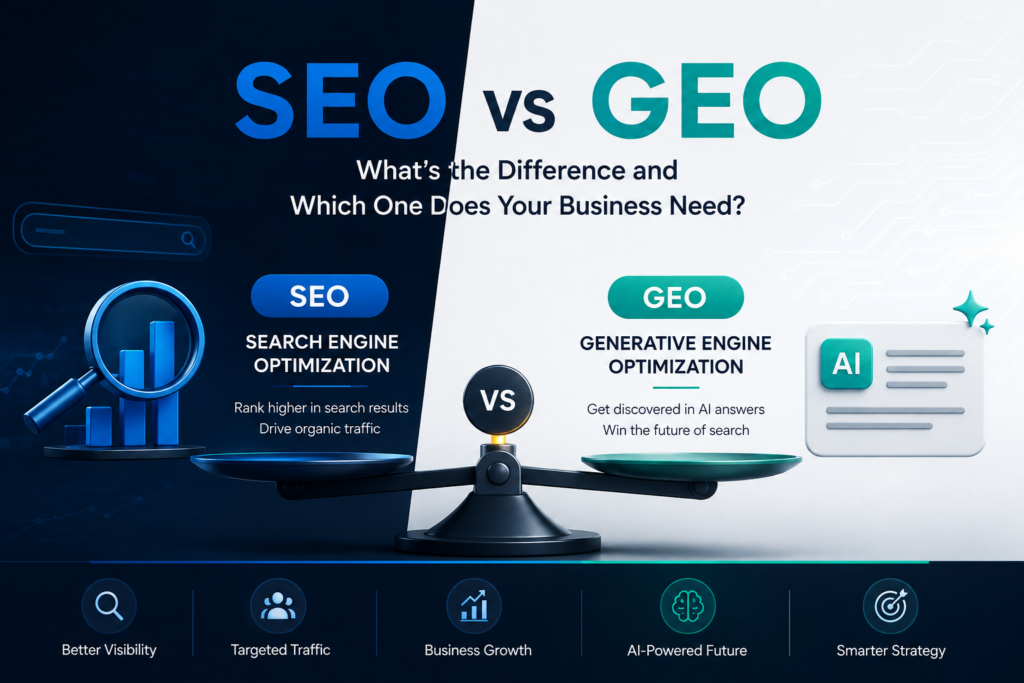
Search is involving rapidly than the expectations of marketing teams. Ranking first on SERP(search engine result page) was the benchmark for SEO success few years ago. Your next customer might never type keyword into Google result, Instead they ask ChatGPT, Gemini, Perplexity or Google AI for answers and trust the result recommended by those platforms.
This shift has created a new challenge for the businesses, to rank their websites.
You can rank your website on Google search result page, publish the content consistently but still lack and remain invisible to the AI tools which answers the questions of your customers.
This is where the Generative Engine Optimisation (GEO) plays a affective role.
Traditional practices for SEO, focuses on improving the visibility of the website on search engine result page unlike them GEO makes your content discoverable, understandable and trustworthy so that AI algorithms and LLM models that makes AI powered search systems to take the refrence while generating the answers for the user.
For the businesses who are investing in digital or performance marketing and want their business to build a viable social media presence, this is not another buzzword, it is the next evolution of organic visibility.
At RACTMEDIA, we don’t see SEO will be replaced by GEO. We see this as reshaping the definition of effective search result. Brands that adapt early won’t just appear in search rankings, they will be the authentic sources for the AI platforms guiding users.
What is Generative Engine Optimisation?
Generative Engine Optimisation or GEO, is the practice of optimising the content so that AI platforms can easily understand, extract and present it to the user while generating responses.
Think of it this way,
Traditional SEO asks:
“How do we target the right keywords?”
GEO asks:
“How do we answer the question so completely that AI doesn’t need another source?”
The difference may have not major variations but it changes how content will be created, which will directly affect the GEO or Generative Engine Optimisation of the website.
Ranking of the website still matters because strategical SEO practices increases the discoverability. GEO builds the structure of the foundation by making your content easily readable so that AI systems can understand the structure, semantic relevance, genuine expertise and topical authority.
Businesses often miss this shift because their primarily focus is only on the keywords,
The winners in AI search will be the brands who publish the content that answers their questions efficiently.
Understanding the Difference between:
GEO vs SEO
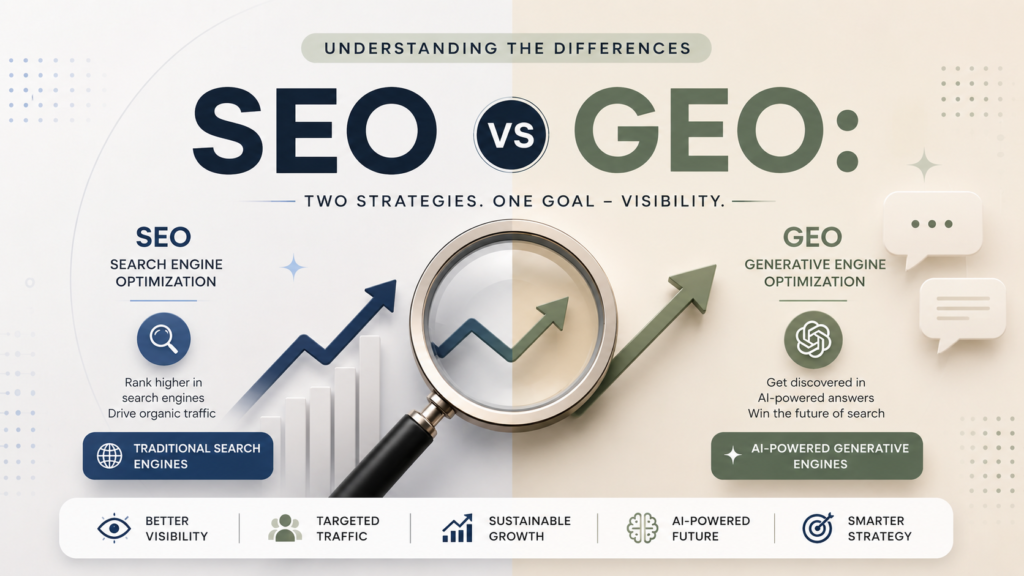
Both GEO and SEO work together in same way but they solve different problems.
| Traditional SEO | Generative Engine Optimization |
| Improves website visibility in search engine results | Improves the visibility of the content in AI generated answers |
| Focuses primarily on rankings and organic clicks | Focuses on the citations, mentions and trust of the AI |
| Optimises the content for search crawlers | Optimises the content for AI understanding and data retrieval |
| Measures the keyword positions and traffic | Measures the AI visibility of the site with traditional SEO |
| Builds authority through the search performance | Builds the website authority through content quality and context. |
Businesses should not choose one over the other, but strongest strategies in digital marketing combines the both.
SEO brings people to your website, GEO(Generative Engine Optimisation) positions your expertise as the direct answer to complex user queries.
Why your Digital Marketing strategy needs to think beyond Google?
Search engine optimisation revolves around one goal for more than two decades, improving the ranking of your website on Google. The process was straightforward, research keywords, create helpful content and earn quality backlinks, improve technical SEO and climb the search result page.
That strategy still matters, however search behavior is evolving daily.
Today user’s ask questions like :
“What’s the best CRM for manufacturing companies?”
“Which SEO agency understands AI search?”
“How do I automate customer support?”
Users receive an AI generated answers within seconds instead of scanning ten blue links. If your brand isn’t included in that answer, you have lost the visibility before a visitor even has the opportunity to click on to your website.
This is why modern digital marketing teams are expanding there SEO strategy beyond tradition rankings.
According to recent industry survey, marketers are beginning to use AI tools like ChatGPT, Gemini and perplexity to monitor the AI overview impressions and track brand mentions alongside conventional SEO metrics. These emerging trends are becoming part of how businesses evaluate search visibility.
The goal is no longer ranking.
The is becoming a trusted source.
Why businesses are thinking about GEO the wrong way?
One of the most common misconceptions in this industry is that publishing content with ChatGPT automatically means you’re doing AI SEO.
It doesn’t work that way.
Using AI to write content and optimising the content for AI search are both completely different activities.
Imagine two companies.
Both publish an article titled “Best Marketing Automation Tools.”
The first company generates a generic article using AI, changes a few headings, and publishes it.
The second company interviews its implementation team, explains common migration mistakes, compares platforms based on real client experience, includes original screenshots, adds structured data, and records a short video summarizing the article.
Both pages target the same keyword.
Only one gives AI systems something worth citing.
That’s the difference between content production and Generative Engine Optimization.
One creates content.
The other creates authority.
The RACT GEO Framework
We recommend focusing on five essential core principles which helps in improving both traditional search visibility and AI discoverability rather than chasing every new SEO trend.
1. Building Topical Authority
Publishing single article on SEO won’t make your business on authority.
Publishing a library connected with covering local SEO, technical SEO, AI search and semantic SEO, content strategy and search engine marketing helps in getting better results and sends a much stronger signal.
Google and other AI systems both understands the topics and relationships between them.
That’s why content clusters consistently outperform isolated blog posts.
2. Create Original Information
Most businesses owner published the summaries only, very few publish insights.
Competitors find it difficult to copy the expert opinions, internal frameworks, campaign data, customer observations and implementation lessons.
Hundred of websites have already repeating information available which is less valuable than the original content created.
If your content doesn’t add something new to the conversation AI will not prefer it over existing sources present on the web.
3. Write for Questions, Not Just keywords
People don’t search using exact keywords that suits your content perfectly.
They ask complete questions now,
your content should answer those questions naturally.
Instead of focusing primarily on keyword density, focus on covering the topic comprehensively.
A page performs far much better that answers releated question thoroughly rather than which repeats the same content twenty times.
4. Help AI Understand Your Content
Well structured content benefits both readers and LLM’s
Using descriptive headings, logical sections, concise paragraphs and schema.org markup where appropriate.
Think of structures as reducing friction, the easier your content is to interpret, the easier it becomes for AI systems and LLM’s to extract and scrap the useful information present.
5. Keep Your Content Alive
Publishing the content is not the finish line, update, review and expand the strongest performance article regularly.
As AI search evolves, fresh examples, updates and recommendations help maintain relevance while strengthening your authority over time.
6. Diversify Your Content Beyond Blog Posts
You will be leaving the opportunities on the table if your entire strategies of SEO are revolving around only written articles or blogs.
AI platforms recognize the pages which combines multiple formats of content. A blog which includes the short video, an infographic or practical checklist often provides more affective value then text alone. According to IMPROVADO summary on AI marketing guidance, one AEO beta test reported a increase of 20% AI driven traffic after blog posts were enhanced by video summaries.
For social media and digital marketing teams, this doesn’t mean investing there money in expensive production. Explaining the key points of your article or blog in 2 minutes videos or visual workflow can help in improving the user engagement significantly while giving AI systems more context about your expertise.
The main goal of GEO (Generative Engine Optimisation) isn’t simply to publish more content, it’s to publish the content that can be easily understandable, easier to trust and easier to reference.
Common mistakes that hurt Generative Engine Optimisation
Many businesses believes that they are following a modern SEO strategy, but in reality they are actually repeating the outdated practices.
Here are some of the common mistakes we see :
-> Publishing AI generated content without adding any expertise in it.
AI can helps in accelerating research and drafting the content but it can replace the expertise of
human being.
If your article is identical to the hundreds of other online articles or blogs, then neither the
readers nor the AI systems can have the affective reason to trust or refrence it.
-> Obsessing over keyword density
Many digital marketer spend too much time in counting the keyword occurrences in the content,
a better approach to answer every important question releated to the topic.
For Generative Engine Optimisation (GEO), semantic depth always beats the keyword
repetition in the content.
-> Ignoring internal linking
Every blog on your website should strengthen another page.
For example, this article should naturally connect with your pages on:
- Digital Marketing Services
- Search Engine Optimization
- Search Engine Marketing
- AI Automation
- Content Marketing
- Technical SEO
-> Treating Generative Engine Optimisation as a replacement for SEO
This is probably the biggest misconception,
Generative Engine Optimisation will not replace the tradition SEO, without strong technical SEO,
quality content, site speed and authority GEO can become harder to execute without these key
points and can’t be successfull.
How to Measure the Success of Your GEO(Generative Engine Optimisation) Strategy?
The success of your GEO strategy should have traditional SEO metrics beacuse that metrics still matters the most, organic traffic, rankings, impressions adn conversions remains essential.
However, there are some essential additional performance indicators worth monitoring which are introduced by the GEO (Generative Engine Optimisation).
Track metrics such as:
- AI Overview visibility
- Brand mentions across AI platforms
- Organic traffic growth
- Time on page
- Click-through rate
- Branded search volume
- Engagement with supporting content like videos and guides
The Future of Generative Engine Optimisation
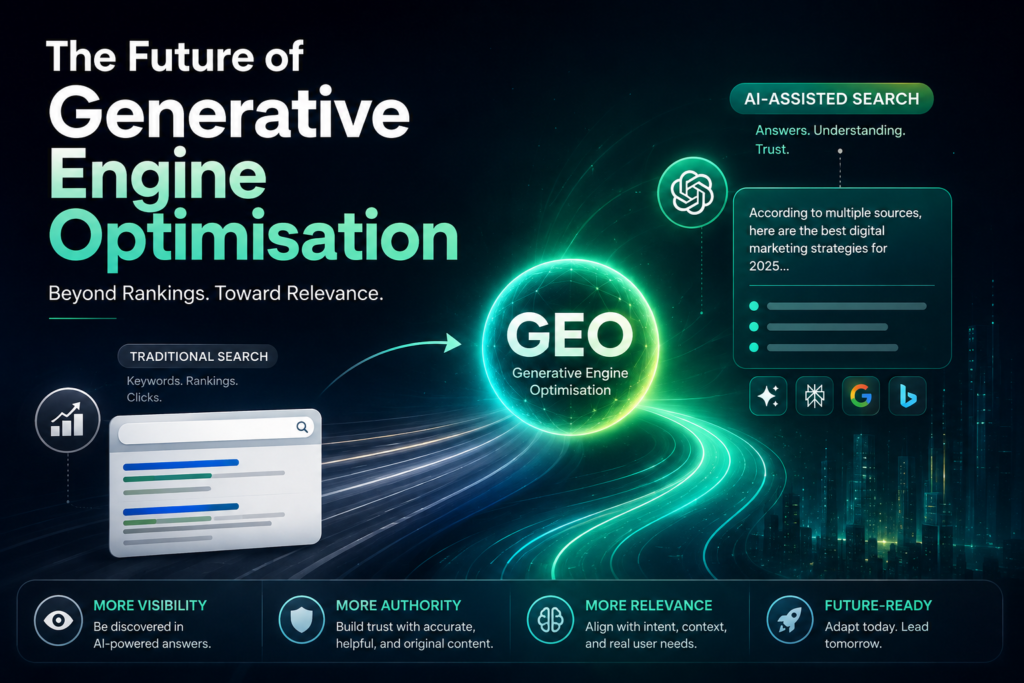
AI assistants are becoming an important part of how does people research about the products, compare different types of services according to there specific needs and taking the purchasing decisions.
Therefore, we can say that search is no longer limited to search engines.
Continue Relying solely on traditional SEO for your business can still perform better today, but they will be less prepared because the AI assisted search becomes more common.
The brands which are successful in their niche, it is not necessary that they will publish the most content.
They will publish the most useful content. This means instead of chasing shortcuts, they will be investing in original insights, topical authority, structured information and genuine expertise to increase the visibility of their business.
Generative Engine Optimisation shouldn’t be viewed as another marketing trend by Digital Marketing Teams. It should become a natural extension of an already strong SEO strategy.
Conclusion
The way search is evolving currently, businesses need to adapt with it.
Ranking on Google is valuable, but visibility inside LLM’s like ChatGPT, Google AI Overviews, Gemini and other AI platforms is becoming important for long term digital growth.
That is the reason why Generative Engine Optimisation is considered in every modern digital marketing strategy. Instead of producing more content, our focus should be on creating content worth refrencing, instead of chasing keyword densite, build tropical authority.
Businesses that will make this shift today, will be positioned better in the future search, if your business wants to improve both traditional SEO performance and AI search visibility,
RACT Media’s SEO & search engine marketing services can help your brand to build a affective strategy designed how people search today and how they will search in the future.